
If there’s one thing we’ve all become certain of in recent years, it’s that the switch to a zero-carbon economy is coming – from renewable energy to logistics & transportation.
The switch to zero-emission vehicles forms a key part of this global approach, with road transport currently responsible for more than 60% of oil consumption worldwide.
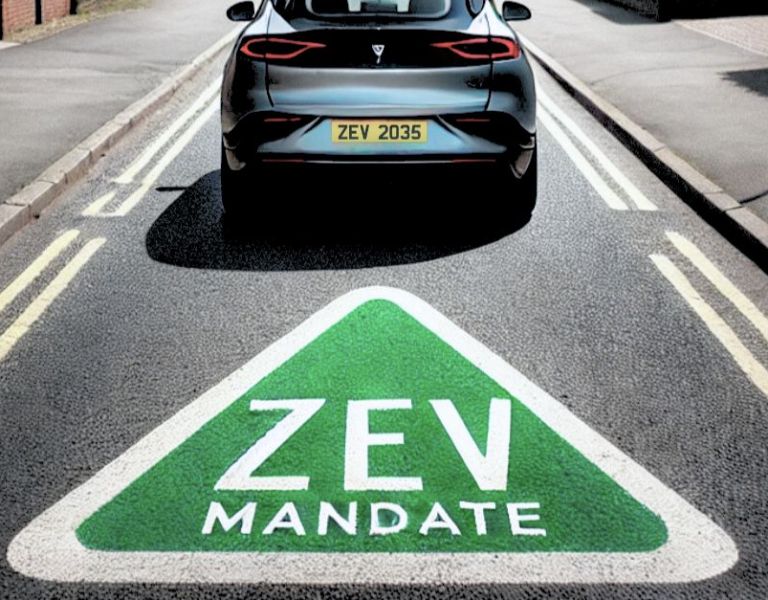
That’s where the UK’s ZEV Mandate comes in, introduced by the government in 2024. It provides clear guidelines for car and van manufacturers, to ensure they’re focused on promoting zero-emission vehicle (ZEV) uptake – requiring an increasing portion of vehicles they produce to be zero-emission each year, reaching 100% by 2035.
Here, we discuss the ins and outs of the ZEV mandate – including what it means for manufacturers, and critically, how it might impact drivers…
What is the UK ZEV mandate?
The UK ZEV (Zero Emission Vehicle) mandate was introduced in 2024, and dictates that all new cars and vans sold in the UK by 2035 must have zero carbon emissions at the tailpipe.
The mandate sets out year-by-year goals for manufacturers, dictating the proportion of their new vehicles which should be Zero Emission each year up until the deadline. These are:

The ZEV Mandate targets are:
- 2025: 28% for Cars (16% for Vans)
- 2026: 33% for Cars (24% for Vans)
- 2027: 38% for Cars (34% for Vans)
- 2028: 52% for Cars (46% for Vans)
- 2029: 66% for Cars (58% for Vans)
- 2030: 80% for Cars (70% for Vans)
Reaching 100% by 2035…
* % Of new vehicles which the ZEV mandate requires to have Zero Emissions at the tailpipe for each year until 2035.
If manufacturers fail to meet these targets, hefty fines of up to £15,000 per vehicle can be applied. However, there is some flexibility – manufacturers can trade credits either with one another, or borrow them from future years, to offset any imbalance in ZEV production.
Will all vehicles need to be electric by 2035?
No – a common misconception of the ZEV mandate is that all vehicles on the road will need to be electric by 2035. This is incorrect for a couple of reasons, clarified below:
Zero Emission Vehicles don’t need to be electric
While the ZEV mandate dictates that new vehicles must not produce exhaust emissions after 2035, this doesn’t necessarily mean they have to be electric. Advancements in fuel cell technology, hydrogen gas combustion, and zero-emission chemical fuels could also be a major contributor to the ZEV market in the near future.
Only brand-new cars will need to be zero-emission by 2035
The 2035 ZEV deadline only applies to brand-new cars and vans, so it won’t affect owners of petrol, diesel, or hybrid vehicles which were produced before that date. This means internal combustion vehicles could still be on our roads for some time, perhaps long after the ZEV deadline has passed.
Trucks & large HGVs have an extended deadline
Large vehicles like trucks and buses pose a much greater challenge for manufacturers when it comes to achieving ZEV compliance, due to their much heavier weight and extended range requirements. For this reason, manufacturers will still be able to produce ICE and hybrid HGVs beyond the 2035 deadline, although the UK government has previously committed to phasing out their production by 2040.
James Fisher of Gecko Risk, our EV & AFV insight partners, comments on the current pace of ZEV adoption so far in 2024:

“September saw a record number of EVs hitting the UK roads, with over 58,000 new registrations.
However, the average monthly new registration figure across 2024 is 31,430, which is only a 7% increase on 2023.
Clearly growth needs to accelerate well beyond this to meet ZEV mandates.”
“Cheaper makes and models due to hit the road will help with uptake, although high and unpredictable insurance premiums may be a barrier to entry. Insurers can play their part and increase their market share by understanding EV risk data on a make and model basis”.
What does the ZEV mandate mean for drivers?
While the purpose of the Zero Emission Vehicle mandate is to guide manufacturers in their production strategies, it will also undoubtedly have effects on drivers & vehicle owners.

Here’s a look at some of the impacts the ZEV mandate may have on day-to-day drivers:
Will Electric Vehicle prices come down?
The primary goal of the ZEV mandate is to increase the number of zero-emission vehicles produced by manufacturers each year. This vast increase in supply will likely result in lower price tags for EVs in future years, as more makes, models, and specifications head into production.
Many of the EVs currently on the market are high-spec, luxury vehicles – so, as manufacturers turn their attention to promoting higher EV adoption, their focus will likely shift to more practical, affordable models.
Will EVs get cheaper to repair?
The expected increase in EV popularity, fuelled by the ZEV mandate, could reduce the average cost of EV repair – thanks to more repairers becoming EV-ready, and more aftermarket & ‘green’ parts becoming available.
Sourcing affordable parts is one of the most critical factors driving total vehicle repair costs. Because most EVs are fairly new to the market, there aren’t as many affordable options available when it comes to sourcing replacement components. As popularity increases, so should the volume of available parts – potentially shortening repair durations, and reducing parts premiums.
Data from Gecko Risk reveals that average EV repair costs fell year on year from 2022 – 2024, bringing them closer to their ICE counterparts.
Will EVs get cheaper to insure?
Many insurers are still navigating the intricacies of providing cover for electric vehicles. The aforementioned instability in repair costs, coupled with uncertainty about onboard technologies, has left many EV drivers facing higher premiums than they’re used to with petrol/diesel vehicles.
However, as EV popularity increases in-line with the ZEV mandate, so will the data available to insurers to calculate insurability more effectively. This should mean EV premiums become easier to source, at more competitive rates, provided repair costs lessen in-line with the trend of adoption.
Will EV battery life improve?
As the ZEV mandate turns manufacturers’ attention to electric & alternative-fuel vehicles, it’s likely that new battery technologies will emerge, with higher efficiency and longevity than those currently on the market.
Consumers can therefore expect EV battery efficiency, range, and lifespan to improve in the coming years, thanks to increased investment and innovation in the sector. The batteries found in EVs in a decade will likely look vastly different to the lithium-ion cells found in vehicles today – only time will tell which solution will conquer.
Will there be enough charging stations by 2035?
One of the main concerns surrounding mass EV adoption is the availability of public charging stations – in the right locations, with the right adapters, and with renewable energy sources.
According to a report from the UK’s Electric Vehicle Energy Taskforce, the country will need between 253,000 and 661,000 publicly-available charging points to meet demand by 2035.
While speculation remains high, the data does look promising. Latest reports from Zap Map show a 32% increase in new charging stations in 2024 alone, signifying some progress being made towards the government’s target of 300,000 total devices by 2030.
However, it remains to be seen whether installations will continue at their current rate, and how the government will secure enough renewable energy to power this new infrastructure.
Will we see more Hydrogen vehicles on UK roads?
As mentioned, the ZEV mandate doesn’t require all vehicles to be plug-in electric by 2035 – only that they have no carbon emissions at the exhaust. It’s therefore likely that manufacturers will earmark strong investment for exploring alternative powertrains, like hydrogen fuel cells and renewable combustables, meaning these vehicles could also become increasingly common on our roads.
Fuel cell technology is also much more applicable to larger vehicles, like HGVs and buses, which require higher efficiency to get their required range. This means that, although plug-in electric cars may remain the norm for now, fuel cells will likely make a significant contribution to reaching ZEV targets across all vehicle classes.
Activate Group: Powering the Future of EV Claims
At Activate Group, we’re paving the way for a seamless transition to electric vehicles throughout the claims & repair process. Through our UK-wide facilities, in-house supply chains, and strategic partnerships, we’re ready to support insurers, fleets, and drivers with EV-ready incident response, engineering, repair, and intelligence solutions.

EV-ready Activate Accident Repair Bodyshops
All of our Activate Accident Repair centres are fully equipped to handle EV and hybrid repairs across the UK. With dedicated EV bays, specialised technician training, and in-house ADAS calibration, we ensure that all repairs align with the latest safety & quality standards, and deliver competitive cost & turnaround.
Supporting electrification in fleet through sopp+sopp
Through group business sopp+sopp, we actively support some of the UK’s best-known fleets in their shift to electric commercial vehicles. From providing granular performance data to inform EV adoption, to delivering industry-leading EV repair, we’re committed to supporting helping the industry increase confidence, and accelerate adoption of zero-emission vehicles.
Building more sustainable EV repair supply chains
We’re forging partnerships to enhance efficiency right across the EV supply chain, ensuring streamlined access to sustainable parts, environmentally responsible vehicle disposal, and sustainable repair practices that reduce waste, and keep costs manageable.
Partnering with leaders in EV & AFV insights
Through our partnership with Gecko Risk, we offer insurers access to detailed accident metrics and insights for the latest EVs. From market-wide repair costs and cycle times, to parts availability and labour rates, our data-driven insights help insurers apply active risk management, and benchmark claims performance against the wider industry.
To learn more about Activate Group’s range of technology-driven accident & repair management solutions, get in touch: